
- 2025
- Statistics
Breaking Down Barriers: 5 Key Statistics on Youth Employment in 2025
Insights from Olivia Dams, Youth Employment UK
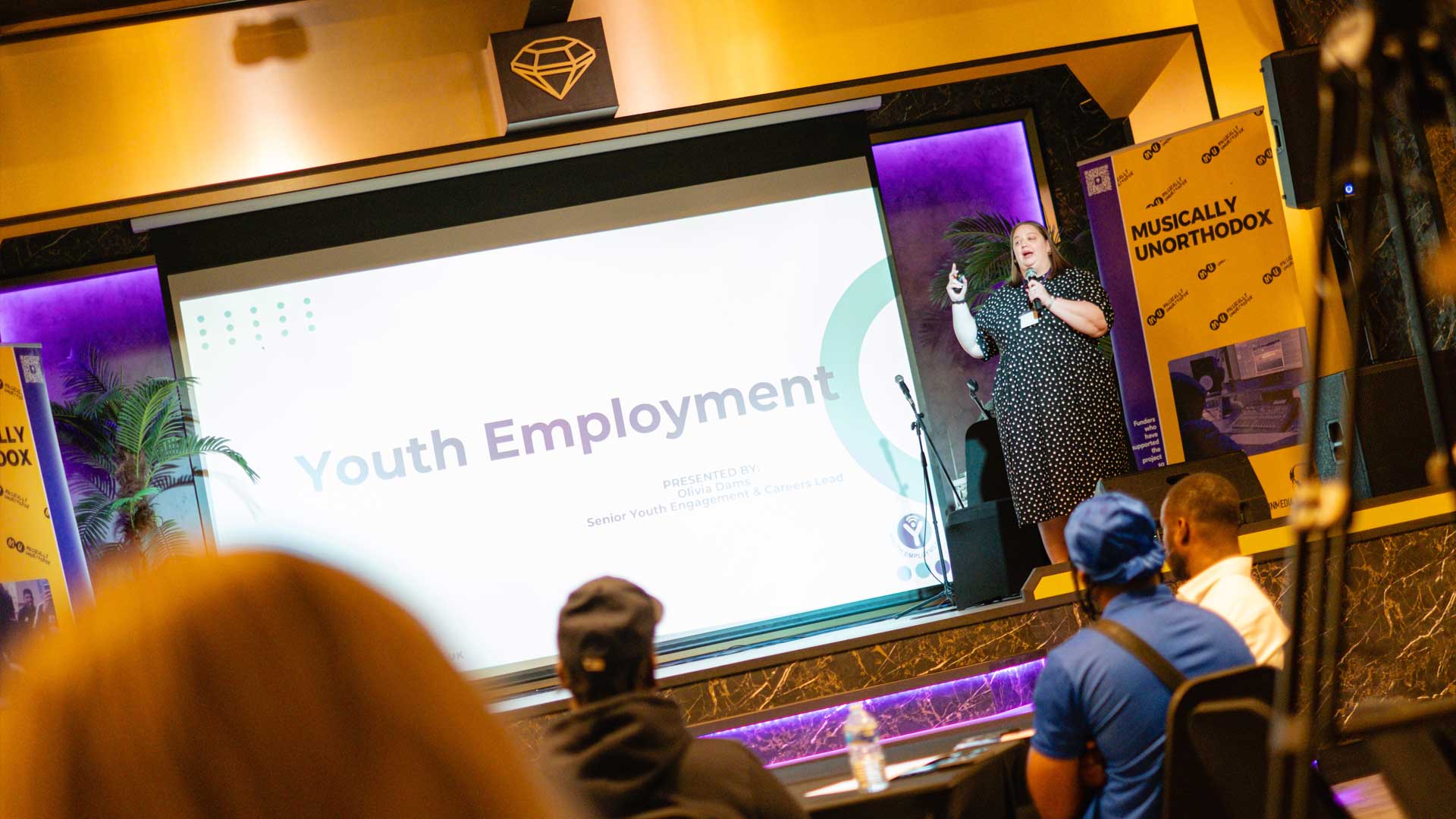
At the Musically Unorthodox Conference 2025, Olivia Dams, Senior Youth Engagement and Careers Lead at Youth Employment UK, took the stage to deliver a sobering yet vital snapshot of the youth employment landscape in Britain today.
With only six weeks in her role, Dams was characteristically modest about her expertise. But the data she presented drawn from the organisation’s annual Youth Voice Census, the largest survey of its kind in the UK painted an urgent picture of the barriers facing young people aged 11–30.
For anyone working in youth talent development, music education, or community outreach, these are the statistics you need to know.
1. Nearly One Million NEET Young People
987,000
That is the current number of young people in the UK not in education, employment, or training (NEET).
While overall UK unemployment sits at just over 4%, youth unemployment is over 14%. The fiscal cost of large-scale youth unemployment over the last four years is estimated at £31 billion.
“Youth unemployment has been a rising issue in the country since 2005,” Dams reminded the room. “This isn’t new—but it is getting worse.”
2. The Long-Term 'Scarring' Effect
Young people who experience long periods of unemployment are:
Less likely to access higher-paying roles later in life
More likely to experience repeated periods of unemployment
This is what Dams called “long-term scarring” a permanent dent in earning potential and career trajectory caused by early instability.
“It’s not just about the impact on that individual young person,” she said. “It’s about the economy, the system, and the generations that follow.”
3. The Two Biggest Barriers: Experience & Anxiety
When Youth Employment UK asked over 5,000 young people what stands in their way, two answers dominated:
1. Lack of work experience and quality job opportunities in their local area.
Young people cannot get jobs without experience and cannot get experience without jobs. This catch-22 is exacerbated for those in rural communities and coastal towns, where public transport is poor and opportunity is physically out of reach.
2. Mental health and anxiety.
Young people are anxious about money, discrimination, safety, and global instability. From the war in Ukraine to the cost-of-living crisis, they are hyper-aware and hyper-vulnerable.
“Because of social media, young people are more connected to global issues than ever before,” Dams explained. “That awareness comes with a mental health cost.”
4. Who You Are Still Determines Your Access
Systemic inequality remains a stubborn gatekeeper. Dams outlined six factors that disproportionately affect a young person’s ability to access quality employment:
Disability
Ethnic minority background
Care leaver status
Where they live (postcode as destiny)
Socio-economic background
“These are things that can’t be helped,” Dams said. “But they are things that affect a young person’s ability to access quality employment. That is on us, employers, educators, and policymakers—to fix.”
5. The Qualification Funnel: Losing Talent at Every Stage
Dams shared a visual that stopped the room.
Imagine a pool of young people leaving education. Now apply common employer requirements:
| Barrier | Estimated Talent Lost |
|---|---|
| Require GCSE Maths & English pass (first time) | 40% |
| Require a CV formatted ‘correctly’ | Another significant chunk |
| Require prior work experience | Another significant chunk |
| Require local access to opportunity | Final narrowing |
“By the time we’ve applied all our filters, we’ve lost huge numbers of capable young people, not because they lack talent, but because the system lacks flexibility.”
What Can We Do?
Dams closed with an invitation, not a lecture.
The Youth Voice Census 2025 is open now. Any young person aged 11–30 can complete it. The results are presented in Parliament, shared with policymakers, and used to influence real change in employment policy and practice.
“Young people are crying out for activities, for youth clubs, for arts and performance opportunities,” she said. “They want to know how to get into industries like music. They just don’t know the door exists or how to knock.”
Speaker details

Watch full presentation



Musically Unorthodox Project
PLATFORM
musicallyunorthodox.com
PROGRAMMES
mucm.inmusicinmedia.com
SOCIAL VALUE
socialvalue.inmusicinmedia.com
Contact
Email: [email protected]
Tel: +44 (0) 7762 545 275