
- 2025
- Motivations
Birth of MU: The Journey from Sound System to System Change
How a reggae sound system became the blueprint for the Musically Unorthodox movement
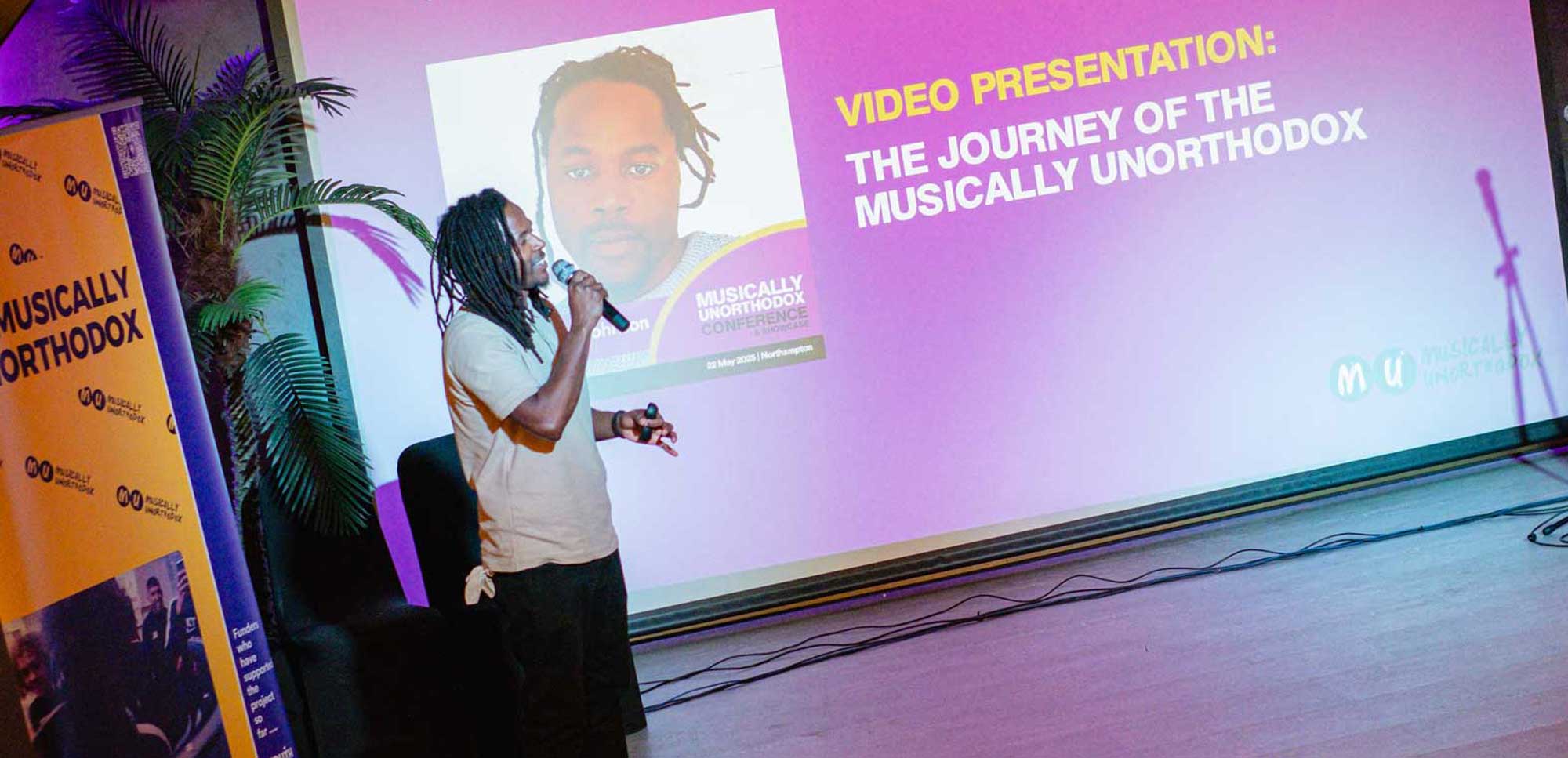
Every movement has an origin story. Not the polished, press-release version, the real one. The one that starts not in a boardroom or a funding application, but in a bedroom, a youth club, a sound system session that ran late into the night.
When Daniel stepped on stage to open the Musically Unorthodox Conference 2025, he didn’t give a speech. He pressed play on a video.
What followed was not a biography. It was a why.
Two Worlds, One Environment
The video opens with a framing that is deceptively simple.
“In our daily lives, we simultaneously play three roles. Family role as a child, parent or sibling. Social role as a friend and being part of the community. A citizen’s role as a student at school and later as an employee or employer at work.”
For Daniel, growing up in the black community, Caribbean culture interpreted through a British experience, these roles created two worlds conducted in one environment.
Outside school: a reggae sound system. Electronics, carpentry, sound engineering, DJing, emceeing, artists, audiences, dancers. Entrepreneurship, community building, skills development. Inside school: the national curriculum. GCSEs. A levels. University. The status quo.
“This set me on two separate pathways.”
The Portfolio That Changed Everything
By Key Stage 3, aged 11 or 12, Daniel had his own sound system with a team, securing local bookings and guest radio slots. By Key Stage 4, he was promoting his own events and touring the UK.
But this level of success outside school wasn’t reflected inside it. He found himself struggling, grades slipping, exam results falling short of his potential.
Determined to pursue the conventional academic route, he stayed in sixth form for an extra five years, topping up GCSEs, topping up A levels, navigating personal challenges alongside institutional ones. Despite his efforts, he didn’t meet the required qualification level according to the status quo. But he still attended his university interview. And he brought his music portfolio.
“This is when I realised my music activities bolstered my academic credibility. With no convincing needed, the course leader said: ‘We need you on this course.'”
The Skills You Can't See on a CV
The course was a business degree based on setting up a business.
Daniel used the knowledge he had acquired through his sound system to set up an internet radio station. The result secured his graduation.
His first job? Designing information leaflets for a charity, a skill learned through designing flyers for sound system events. He was later employed by the same university he attended as an associate lecturer in music and media studies. Again, skills learned through the sound system.
“By this time, many of the peers I started with had fell off. Some getting bogged down with life, doing a job they hated. Others trying different avenues, which unfortunately led them to getting caught up on the wrong side of the law. A key thing I seen was myself and a few others that stayed on the music always seemed to escape the trouble. It kept us focused and earning from something we love doing.”
Why This Work Exists
People began to gravitate to Daniel for advice, guidance and support, especially the youngers.
Not because he had qualifications. Because he had walked the path and was willing to show others where the stones were loose.
“This organically formed a prototype for the Musically Unorthodox Project.”
Realising the need to formalise this process to have a wider reach, Daniel set up In Music In Media as a social enterprise. The primary mission: create an awareness of the transferable skills within music. Sound system culture. Rapping, DJing, digital music production, hip hop, drum and bass, grime and drill.
Setting out as a mobile service, they hit schools, youth centres, youth service providers.
Then came implementation. Funding from Youth Music launched the Musically Unorthodox project, taking cohorts of young people through the process.
“The programme proved to be impacting and resonating with the marginalised demographics. We found ourselves working with NEETs, young offenders, excluded students and others in challenging circumstances.”
The Voices That Keep You Going
The video interweaves Daniel’s narration with the voices of those who have walked through the door.
A young person: “It kept our minds focused on something. Every Thursday we was doing it, all of us was trying not to get excluded. We’ve all been here every day. This is different. This is sovereign joy. And we all want to do what we’ve just done when we’re older.”
Scott Wade, Deputy Head Teacher at Kingsfield College:
“From a school’s point of view, we would like the project to continue for a longer period. Ideally involve other students. This is the kind of thing we would like to introduce to all year groups.”
Sean Connors, Refocus:
“The biggest change I’ve seen is the growth in some of our students, how it’s improved their ability to express themselves. You guys do so many different ways to do that through music video, video editing, songwriting, podcasting. I think it’s a missing link.”
And then, a young ‘Dreadz’ who was actually a panelist at the conference, speaking directly into camera from an project Daniel ran almost a decade ago “If it weren’t for music, right now I’d be on the streets selling things I shouldn’t be selling, chilling with the wrong people. Being in a studio, it’s a different zone for me.”
Why We Keep Going
Daniel closes the video not with a call to action, but with an observation and an invitation.
“We know that for us to do it, it has to be a collective effort. With everyone. All different factions of society.”
He looks at the room, a room full of youth workers, police commissioners, venue managers, educators, young people, industry professionals, funders, policymakers.
“And everyone showed up today.”
Why does this work exist?
Because a young man with a sound system grew up and realised that the skills he learned outside the classroom were not a distraction from his education. They were his education.
Because he watched peers fall into jobs they hated, and others fall into systems they couldn’t escape, and he saw that the ones who stayed on the music always seemed to find a way through.
The system is not going to fix itself. So we are building another one, alongside it. Not to replace what exists but to provide an alternative solution.
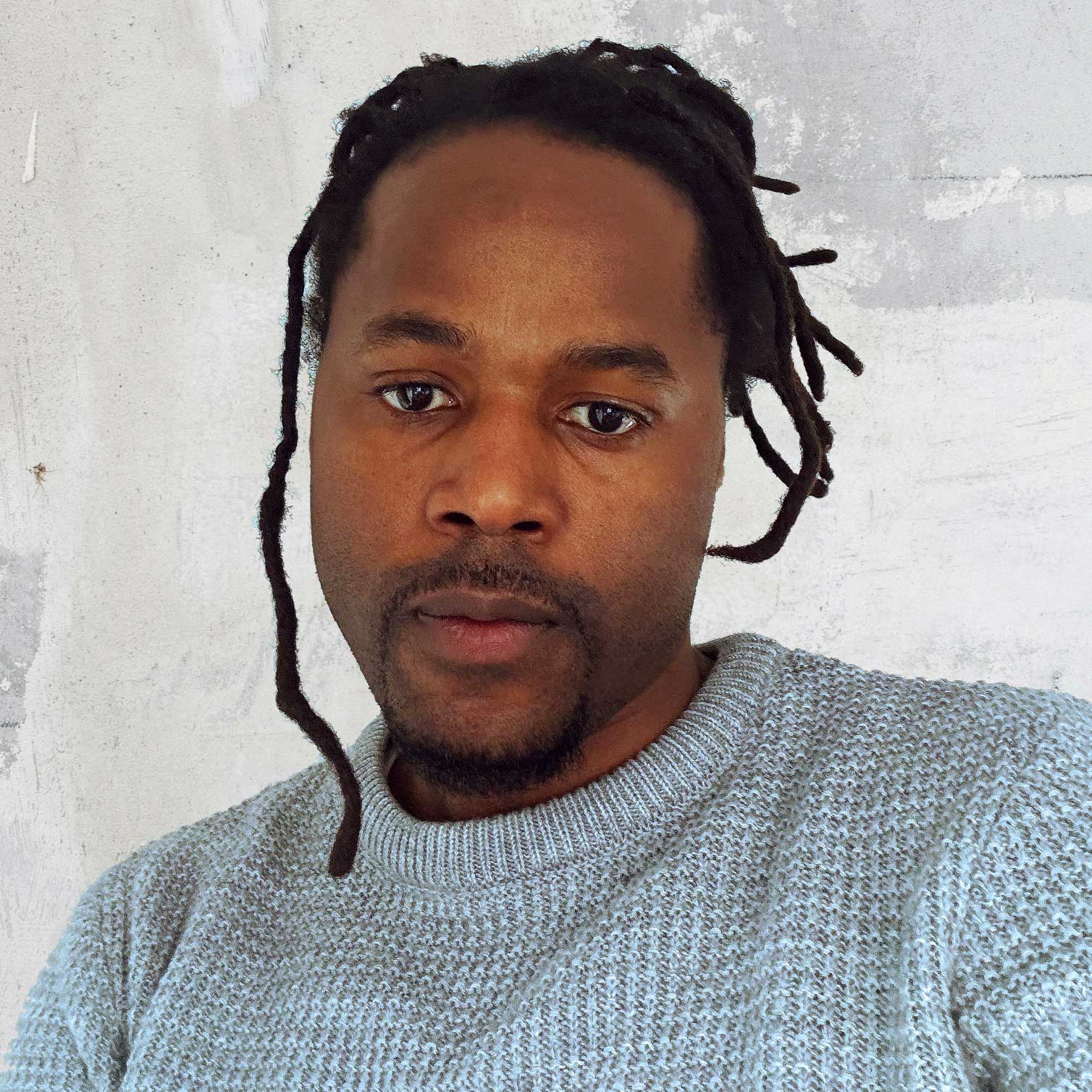
Speaker details
Watch film



Musically Unorthodox Project
PLATFORM
musicallyunorthodox.com
PROGRAMMES
mucm.inmusicinmedia.com
SOCIAL VALUE
socialvalue.inmusicinmedia.com
Contact
Email: [email protected]
Tel: +44 (0) 7762 545 275