
- 2025
- Conversations
Joining the Dots: Why Pathways Into Music Believes the Future Is Local
Chris Cooke, Pathways Into Music on Mapping Careers,
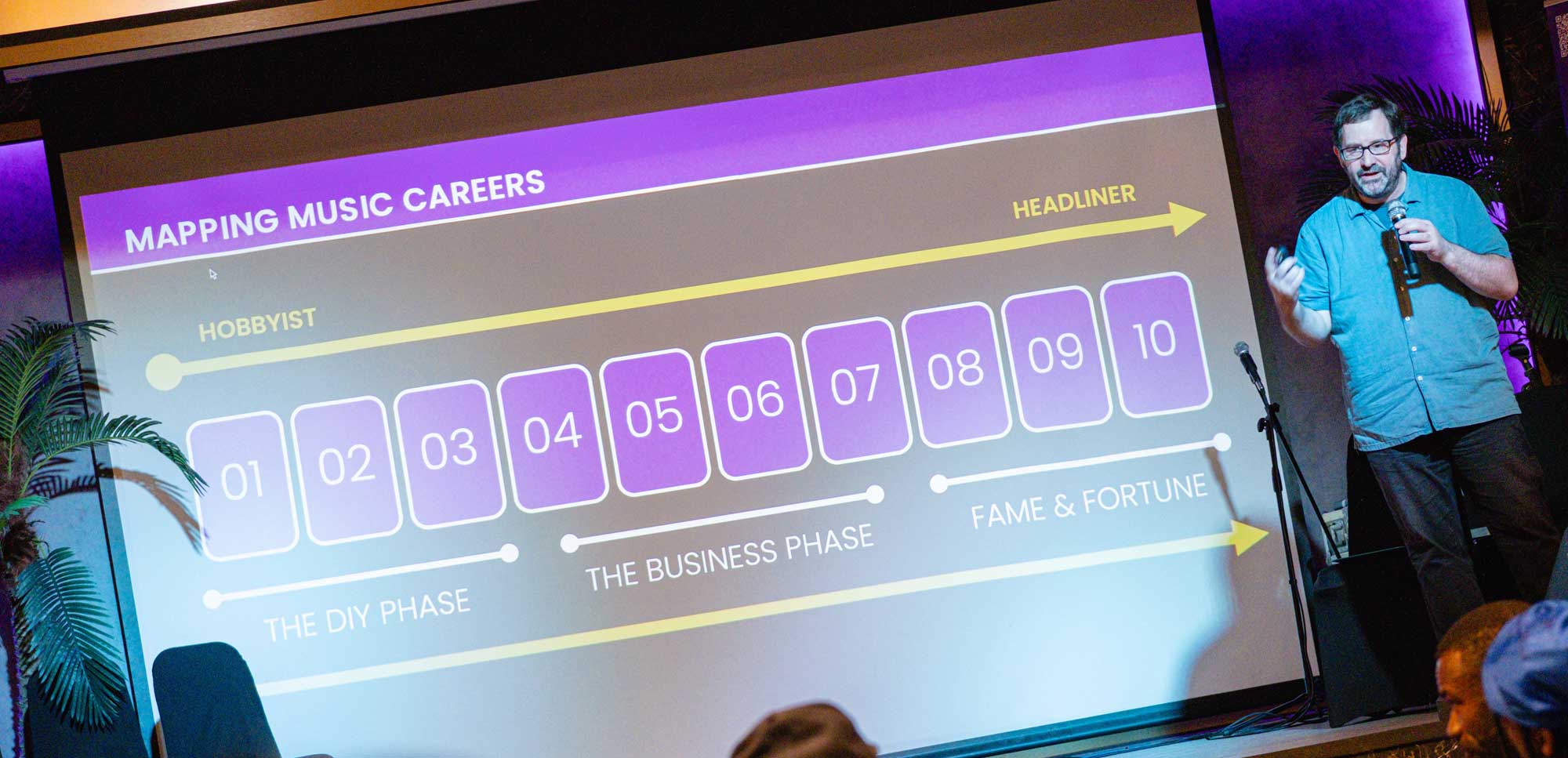
At the opening of the Musically Unorthodox Conference 2025, Chris Cooke, co-founder of the Pathways Into Music Foundation, took the stage not as an expert with answers, but as a learner with questions.
“I’m really here today to learn,” he told the room. “Because I think there’s a lot of information from the speakers and the panelists, just the people in the room about how we can help Daniel and his team achieve what he wants to achieve. Here in Northampton, in the Midlands, and across the UK.”
It was disarming from someone who has spent the last five years doing exactly that: mapping the music industry, its careers, and its connections to education. But it also revealed the core philosophy of Pathways Into Music, and why this conference exists at all.
The problem is not a lack of talent. It is a lack of joined-up thinking.
1. Nearly One Million NEET Young People
Cooke framed the entire day around a single, provocative question:
“We know that music and local music scenes can have a positive impact on young people living in challenging circumstances. It has happened organically throughout history, folk, punk, hip hop. Communities rallied around music, became entrepreneurial, created businesses, created careers. But it happens randomly. In specific places, at specific times. How can we make that opportunity more widely available?”
This is not a rhetorical question. It is the central challenge of Pathways Into Music, and the reason the foundation exists.
But Cooke pushed further.
“And when it does happen, how do we ensure the people who built that community fairly benefit from what they created?”
Because the history of music is also the history of extraction. Communities build scenes; corporations enter, consolidate, and depart. The people who started it are often left behind.
How do we build ecosystems that keep the value where it belongs?
The Silos Problem
Cooke described a music industry that is fragmented not just between companies, but within them.
“Even at Sony or Universal or Warner, the recorded music side and the publishing side don’t necessarily talk to each other. They don’t necessarily understand each other.”
If the industry cannot connect internally, how can it connect meaningfully to education?
And education itself is fragmented. Schools, colleges, universities, exam boards, talent development programmes, youth organisations, studios, venues, online initiatives, BandLabs, each operating in its own space, with its own language, its own funding, its own metrics of success.
“Everyone is doing great things in their own right,” Cooke said. “But we need to join the dots.”
The 10-Step Career
Pathways Into Music has spent five years doing exactly that: mapping the industry, mapping education, mapping careers, and most crucially mapping the resources that exist at each stage of a young person’s journey.
They broke down the career of a frontline artist into 10 steps, beginning with the DIY phase:
“Every artist starting out today is also a label, a publisher, a promoter, an agent. They need to understand what that means.”
But not everyone wants to be or will become a superstar. Many will become portfolio musicians: producers, session players, beat-makers, touring musicians. Others will work in the industry itself: labels, publishing, live, sync, marketing.
“We want to give everybody the opportunity to try to be the next superstar artist if that is what they want. But also to build the skills, contacts, and experience along the way that allow them to build sustainable careers in music and in culture more widely.”
The 'What Next?' Principle
One phrase recurred throughout Cooke’s introduction: “What next?”
“We want everybody involved in this process of teaching, mentoring, supporting young people to always have in your mind: what next? How much can I do to support this young person? And when they’ve got all they can get out of me, where am I sending them?”
No single organisation can provide everything. No college, no youth programme, no venue, no mentor.
The job is not to be everything. The job is to be the next right door.
This is the join-the-dots work that Pathways Into Music has been quietly building for half a decade. And it is why, when Daniel Johnson approached them about a conference in Northampton focused on NEET young people and marginalised communities, the answer was immediate.
“What about all the young people who fall out of the system?” Cooke asked. “How do we reach them? Who has the relationships with those young people? What other people, institutions, initiatives do we need to bring into our map?”
Why Northampton Matters
This is not abstract. It is not policy theory. It is a practical question being asked in a specific place, at a specific time, by a specific group of people.
Northampton is not London. It is not New York. It is not one of the cities where music scenes organically tip into industries with predictable regularity.
But that is exactly the point.
If we can build pathways here in a large town with rural edges, with transport gaps, with a reformed council and a mixed economy then the model can travel. To coastal towns. To post-industrial cities. To villages and estates and everywhere else that talent exists but infrastructure does not.
“How can we make this opportunity more widely available?” Cooke asked.
The answer, he believes, is in this room.
The Invitation
Cooke closed as he opened: not with answers, but with an invitation.
“We’ve got lots of presentations, panels, interviews today. But we’re going to begin with Daniel telling you the story so far, how we got here, and what Musically Unorthodox is trying to build.”
Because the work of joining dots is not a solo project. It is a conversation. It is a room full of people from youth work, policing, education, venues, labels, local government, and the young people themselves, all trying to answer the same question:
How do we make sure the next great music scene is not random? How do we build the conditions for it to flourish on purpose, and for everyone?
Speaker details
Watch full presentation



Musically Unorthodox Project
PLATFORM
musicallyunorthodox.com
PROGRAMMES
mucm.inmusicinmedia.com
SOCIAL VALUE
socialvalue.inmusicinmedia.com
Contact
Email: [email protected]
Tel: +44 (0) 7762 545 275