
- 2025
- Statistics
From Reaction to Prevention: What Youth Violence Data Tells Us About Early Intervention
Insights from Rachel Long, Northamptonshire Serious Violence Prevention Partnership
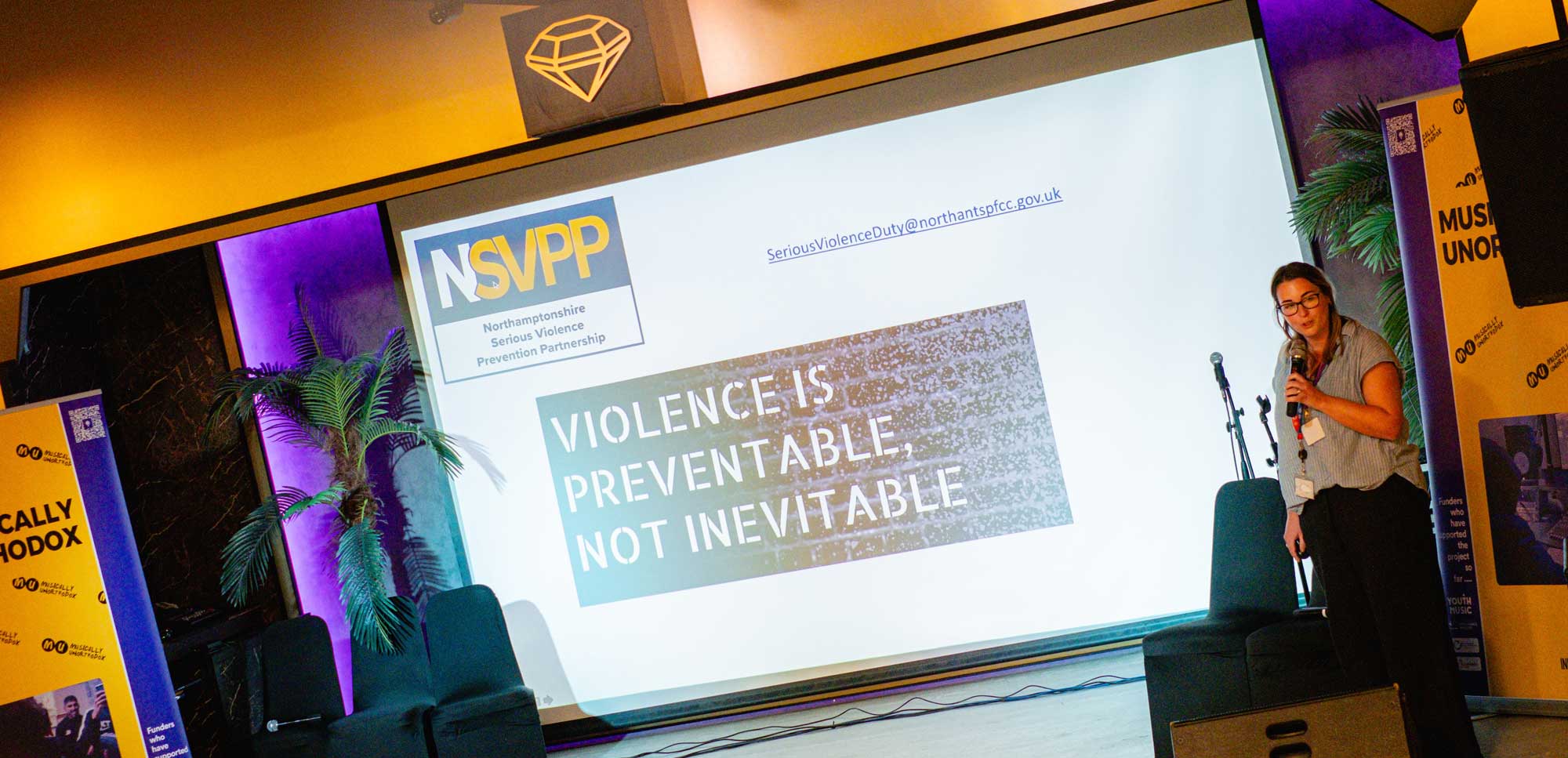
At the Musically Unorthodox Conference 2025, Rachel Long, Programme Manager for the Northamptonshire Serious Violence Prevention Partnership, delivered a presentation that reframed how we understand youth violence, not as isolated criminal behaviour, but as a predictable outcome of systemic failure.
Her message was clear: We intervene too late, and the data proves it. “We usually do the work when the child’s behaviour has escalated, or they’ve been excluded from school, or they’re already in the system,” Long told the room. “That’s when they get support. We need to be in primary schools, in communities, with families years before that point.”
Here are the key statistics and insights from her presentation.
1. The Data Revolution: 19 to 29 Recommendations in One Year
When the Northamptonshire Serious Violence Prevention Partnership launched two years ago, it did something unprecedented: it brought together data from police, fire, local authorities, probation, youth services, healthcare, education, and prisons.
This multi-agency dataset, analysed by the Observatory and OWL analysis allowed them to profile the top 350 perpetrators of serious violence in the region.
The result?
- Year 1: 19 recommendations for action
- Year 2: 29 recommendations
That increase isn’t failure. It’s clarity.
“We could look at that person’s childhood,” Long explained. “We could see the gaps the moments before behaviour escalates into a serious violence offence.”
2. The Root Cause, Not the Behaviour
The partnership’s mandate is to reduce serious violence in the long term. But Long was emphatic: you cannot reduce what you do not understand.
“We need to understand the causes of serious violence. It’s not the behaviour, it’s the root cause.”
This distinction is critical. A young person carrying a weapon or involved in exploitation is not the problem; they are a symptom of problems that began years earlier: exclusion, undiagnosed trauma, family instability, poverty.
Yet the system still operates reactively.
3. The Primary Prevention Gap
Long presented a stark reality: most funding and intervention is triggered after a child has already been excluded, arrested, or labelled.
Her partnership is trying to reverse that.
Primary prevention, intervening before behaviour escalates is now the strategic focus. This means:
- Going into primary schools, not just secondary
- Supporting families with substance misuse and instability
- Funding community-based interventions rather than institutional responses
“That’s where our funding is mostly aimed now,” Long said. “Not waiting for the crisis. Stopping it before it starts.”
4. What Actually Works: Three Funded Interventions
Long shared three examples of programmes the partnership has funded, each chosen because the data showed a specific gap:
- The Compounds (Hemmingwell Estate)
A music intervention run by CAM, using studio access and creative mentoring to engage young people at risk of exclusion or exploitation. - Athletic Elite
A basketball mentoring programme deployed in schools with high rates of violence and exclusion. It uses sport, psychology, and teamwork to build communication skills and emotional regulation. - Parents Under Pressure
A family-focused intervention for households affected by substance misuse, providing structured support to parents while their children are still young.
“We ask Athletic Elite to go into those schools,” Long said. “We don’t wait for the referral. We go to where the data tells us the risk is.”
5. The Missing Ingredient: Young People's Voices
Perhaps the most telling statistic was not a number, but a methodology gap.
“We found it was important to actually listen to young people. Rather than professionals dictating what we think is needed, we need to hear what young people and communities are saying.”
The partnership now funds Young Ambassadors, a direct channel for youth voice into strategy and funding decisions.
It is a simple shift with radical implications: treating young people as experts in their own lives.
What This Means for the Music Industry
Rachel Long’s presentation was not about music. But for a room full of youth music organisations, talent development programmes, and educators, the implications were immediate.
Music interventions work. The Compounds is not a pilot; it is a funded, data-backed strategy. It exists because the evidence showed that creative engagement reaches young people that traditional services miss.
But Long’s data also challenges us:
- Are we reaching young people before they are referred to us?
- Are we in primary schools, or only waiting for the 16–19 NEET cohort?
- Are we listening to young people, or delivering what we assume they need?
The Bottom Line
The Northamptonshire Serious Violence Prevention Partnership is still young. Two years in, it has moved from 19 recommendations to 29, not because violence is increasing, but because understanding is deepening.
“I have the strategy,” Long concluded. “It’s 39 pages of documents and stats. But what it really says is this: we need to be earlier, we need to be in communities, and we need to listen.”
For anyone working with young people at the margins, that is not just a policy objective. It is a call to action.
Speaker details

Watch full presentation



Musically Unorthodox Project
PLATFORM
musicallyunorthodox.com
PROGRAMMES
mucm.inmusicinmedia.com
SOCIAL VALUE
socialvalue.inmusicinmedia.com
Contact
Email: [email protected]
Tel: +44 (0) 7762 545 275